
1. Understanding the Needs of a Small Amusement Park
Choosing the right roller coaster is an important investment for a small amusement park. Unlike large theme parks, smaller venues often operate with limited land, staffing, and capital budgets. Every attraction must contribute to visitor satisfaction while supporting sustainable operating costs.
Kiddie roller coasters and big coasters serve different market segments. Smaller models provide accessible entertainment for young children and families, while larger rides target teenagers and thrill-seeking adults. The best choice depends on the park’s target audience, available space, expected attendance, and long-term development plans.
Rather than selecting a ride based on its visual impact alone, operators should assess how well it fits the park’s overall attraction mix.
2. Kiddie Roller Coasters: A Family-Friendly Investment
Kiddie roller coasters are designed primarily for younger passengers. Their lower speeds, moderate track layouts, and smaller ride vehicles make them suitable for introducing children to the experience of riding a coaster.
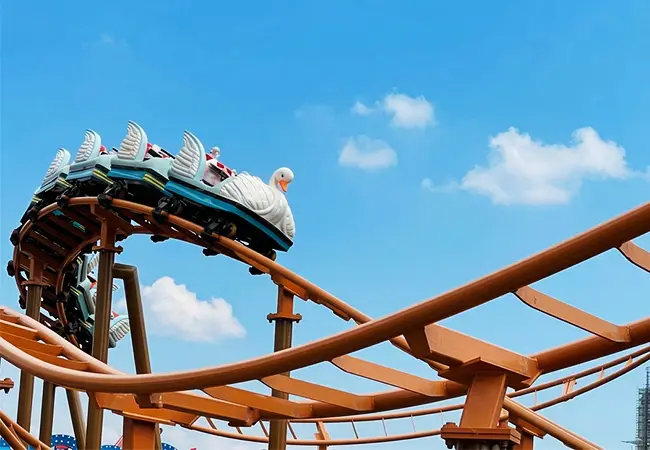
These attractions can serve several commercial purposes. They give families more activities to enjoy together, encourage longer visits, and help parks appeal to visitors with young children. Their compact footprints also make them easier to integrate into existing family zones.
Operational considerations are equally important. Smaller trains and simpler ride layouts may require fewer resources for daily operation. However, operators must still account for passenger height restrictions, restraint systems, inspection procedures, and regular maintenance.
For small parks with a strong family-oriented customer base, a kiddie coaster can provide consistent appeal without requiring a large construction area.
3. Big Coasters: Creating a Stronger Thrill Profile
Big coasters offer a different attraction strategy. Greater heights, higher speeds, steeper drops, and more complex track layouts create stronger physical sensations and visual excitement. They can become signature attractions that distinguish a park from competing entertainment venues.
A large roller coaster may also attract teenagers, young adults, and thrill enthusiasts who specifically seek high-intensity experiences. Its prominent structure can improve the park’s visibility and provide recognizable imagery for advertising campaigns.
However, these benefits come with additional requirements. Larger rides generally need more installation space, stronger foundations, more complex mechanical systems, and greater attention to structural and operational safety. Their construction and maintenance costs can also be substantial.
Small parks should evaluate whether their visitor volume and ticket revenue can support these requirements before committing to a major installation.
4. Comparing Space, Costs, and Operational Requirements
The physical footprint is often the first consideration when choosing between the two coaster types. Kiddie models can fit into compact family areas, leaving room for additional attractions, landscaping, and visitor facilities. Big coasters may occupy a significant portion of the site and influence the layout of surrounding facilities.
Initial investment is another important factor. A smaller coaster generally involves a lower equipment and installation budget, although actual costs depend on capacity, configuration, customization, and site conditions. Larger models require more extensive engineering and infrastructure.
Operating expenses should also be considered. Electricity consumption, staffing, spare parts, inspections, and maintenance all contribute to the total cost of ownership.
A roller coaster for sale should therefore be evaluated according to its complete project cost rather than its purchase price alone. Operators should compare expected passenger throughput, daily operating hours, maintenance requirements, and potential ticket revenue before making a decision.
5. How to Select the Right Roller Coaster for Sale
Before purchasing a coaster, small amusement parks should establish clear investment priorities. The target age group is a useful starting point. A family park may benefit more from a compact ride that accommodates younger visitors, while a destination seeking to attract thrill enthusiasts may need a more intensive attraction.
Several practical factors deserve attention:
- Available Space: Check the track footprint, clearance zones, queue area, and maintenance access.
- Passenger Capacity: Estimate hourly throughput based on train configuration, dispatch intervals, and operating hours.
- Safety Requirements: Review restraint systems, emergency procedures, applicable standards, and passenger restrictions.
- Installation Conditions: Assess foundation requirements, transportation access, and local construction conditions.
- Maintenance Support: Confirm spare parts availability, technical documentation, and after-sales service.
These factors help operators identify a model that matches their financial resources and operational capabilities. They also reduce the risk of purchasing equipment that is visually impressive but difficult to integrate into the existing park.
6. Why Work with Beston Rides on a Small Park Project?
Working with an experienced amusement ride manufacturer can simplify equipment selection and project planning. Beston Rides supplies different types of roller coaster designed for amusement parks and family entertainment destinations.
For smaller projects, the selection process should begin with the site’s dimensions, target passenger groups, and expected operating capacity. The manufacturer can then help evaluate suitable track configurations, train arrangements, and technical specifications.
Buyers should also clarify production schedules, transportation arrangements, installation responsibilities, commissioning procedures, and warranty coverage before signing a contract. These details influence the overall project timeline and long-term operating experience.
A suitable supplier should provide clear technical information and practical support throughout the project, rather than focusing exclusively on the ride’s appearance or headline specifications.
7. Making the Right Choice for Long-Term Park Growth
Kiddie roller coasters and big coasters are not direct substitutes. Each serves a different audience and contributes to the park’s attraction portfolio in a different way.
For small amusement parks with limited space and investment budgets, a kiddie coaster is often a practical starting point. It supports family-oriented positioning and leaves more room for other attractions. A big coaster may be more appropriate when the park already has sufficient visitor demand, financial resources, and infrastructure to support a major thrill ride.
The best investment is not necessarily the largest or fastest coaster. It is the attraction that matches the park’s audience, operating capacity, and development strategy while providing a sustainable visitor experience.